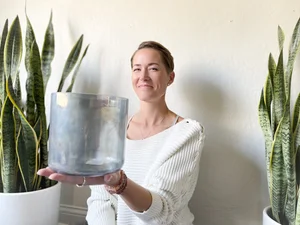
Can a Virtual Sound Bath Actually Work?
A note before I get into this: I resisted virtual sessions for a long time. Like, a really long time. I'm someone who believes deeply in the power of being in a room together — the shared breath, the collective exhale, the almost imperceptible shift in energy when a group of people all surrender to the same experience at the same time. So when people started asking me about virtual sound baths, my honest answer for years was: I don't think it translates.
I've changed my mind.
Here's why:
The skepticism around virtual sound baths is understandable — and honestly, I think it comes from a legitimate place. Most of what's been offered online as a "virtual sound bath" is a pre-recorded track of questionable audio quality, playing through laptop speakers, while someone half-pays attention from their couch. That's not a sound bath. That's background noise.
But that's a quality problem, not a format problem. And once I understood that distinction, everything shifted.
What's actually happening in a sound bath — and why it matters here.
When you attend an in-person sound bath, crystal singing bowls produce rich, layered frequencies that your brain and body respond to in a specific, measurable way. Your brain begins to shift out of beta waves — the busy, processing state you spend most of your day in — and into alpha, then theta. Theta is the sweet spot: the creative, meditative, deeply restorative state that most of us almost never access voluntarily. Your cortisol drops. Your heart rate slows. Your nervous system finally gets a moment to exhale.
This isn't woo. Research published in the Journal of Evidence-Based Integrative Medicine found significant reductions in tension, anxiety, and depressive symptoms following a single sound meditation session — including in participants who had never meditated before. A separate study documented measurable physical benefits including reduced blood pressure and heart rate.
Your nervous system is responding to the sound frequencies. And sound, unlike touch or eye contact, absolutely travels through a speaker.
The real question: does it survive compression?
Most instruments don't survive digital compression well. When sound gets converted into a digital signal and transmitted over the internet, it loses information. For crystal singing bowls — which produce complex, layered overtones in the low-frequency range — standard recording equipment flattens the experience significantly. The therapeutic depth gets lost. What you hear is a pretty sound. What you don't get is the physiological response.
This is the real reason so many virtual sound baths don't work. Not the format. The equipment.
I spent years building a professional home studio setup specifically because I believed this problem was solvable. Lauten microphones were designed to capture low-end frequency with the clarity that standard mics simply can't. Combined with a dedicated audio interface, the result is a live stream that holds the full depth and resonance of the bowls. The overtones are there. The body feels it.
What the research says about virtual delivery.
A 2022 study examining online relaxation interventions found results comparable to in-person sessions for reducing stress and improving emotional state. A separate internet-delivered sound healing intervention — conducted virtually over six weeks — documented meaningful improvements in sleep, anxiety, and pain in participants who never set foot in a studio.
Is it identical to being in the room? No. There is something about physical proximity to the bowls that a speaker can't fully replicate. But the brainwave entrainment, the nervous system response, the measurable reduction in tension and stress? Those travel.
Who virtual sound baths are actually for.
Remote or distributed teams who want a genuine shared wellness experience without the logistics of getting everyone in the same room. I've facilitated sessions across multiple time zones — and the feedback is consistently that it feels more real than anything else they've done virtually.
Individuals who aren't local to Indianapolis who want a live, facilitated experience rather than a recording. There's a meaningful difference between listening to a track and being guided through a session in real time by someone who's paying attention to the room — even a virtual one.
Anyone who's been curious but hesitant. A virtual session is a genuinely low-barrier way to find out if this is for you. Your own space, your own blanket, your own pillow.
How to get the most out of it.
Over-the-ear headphones make a significant difference — the fuller frequency response picks up the depth of the bowls in a way earbuds and laptop speakers can't match. That said, earbuds work, and no headphones at all is always an option.
A dark or dim room, a comfortable position (lying down is ideal), and the genuine intention to actually rest — not multitask, not half-listen — will get you most of the way there. Give it fifteen minutes before you decide whether you feel anything. The shift into theta doesn't happen instantly.
If you're curious about bringing a virtual sound bath to your team or event, I'd love to talk.
If you're an individual looking for a live, facilitated virtual session, learn more about what I offer here.